
A CLOSER LOOK
Carpenter ants
Camponotus spp.
A large ant indoors is worth a closer look. The important question is whether it is passing through or nesting in the wood.
Learn what to look for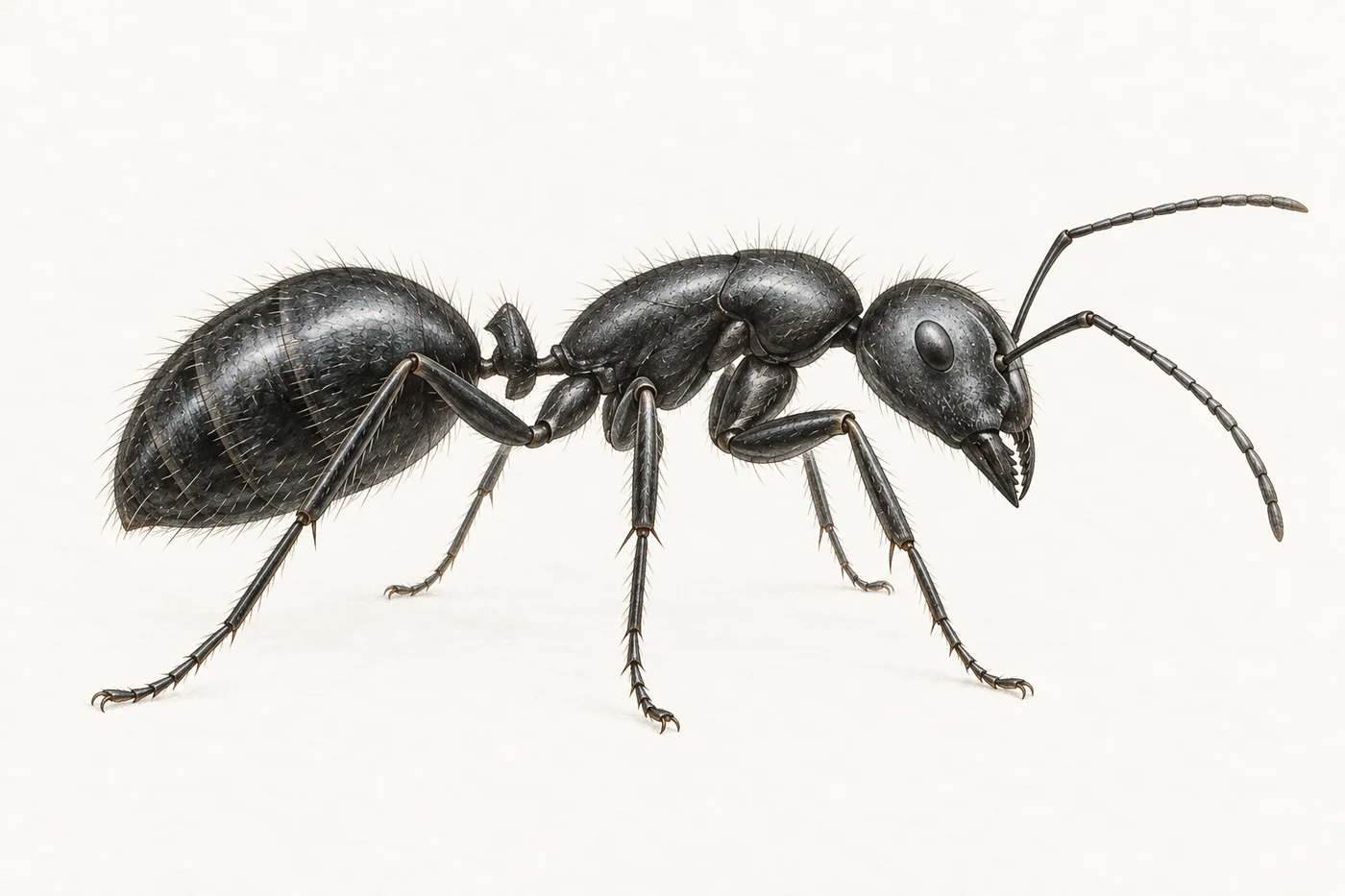
- Size
- Usually ⅜–½ inch
- Look for
- One waist node
- Main concern
- Nesting in wood
01 / IDENTIFICATION
Start with the shape, not just the size.
A smooth, rounded back
Viewed from the side, the section behind the head has an evenly rounded upper edge.
One node at the waist
Look for a single small bump between the middle of the body and the abdomen. A clear side photo helps.
Workers of different sizes
Workers can vary in size within one colony. Color may be black or a combination of red and black.
02 / A CLOSER LOOK
What carpenter ants do to wood
Carpenter ants excavate wood to make room for a nest. They do not eat it. Moisture-damaged wood is a common starting point, although galleries can extend into sound wood.
A sighting is a clue, not a diagnosis.
One worker may have wandered in from an outdoor nest. Repeated indoor activity, coarse wood debris, or winged ants emerging inside deserve a closer inspection. Photograph the evidence before cleaning it away.
03 / COMPARE
Could it be something else?
Can be similar in size. Their back has a noticeable dip rather than the carpenter ant’s smooth curve.
Termites have a broad waist and straighter antennae. Ants have a pinched waist and elbowed antennae.
04 / NEXT STEPS
What to do if you find them.
Follow the activity
Note where ants appear and where they return. A trail is more useful than a count of scattered workers.
Check for moisture
Look for leaks, damp window trim, roof trouble, and wood touching soil. Correcting moisture matters alongside treatment.
Ask for a nest inspection
If the signs keep returning, arrange an inspection. Finding the nest is central to solving the problem.
ENVEXA · GREATER CINCINNATI
Found something at home?
Send a clear photo and tell us where you found it. We’ll help you work out the next step.
Behind this guide
Based on university extension and public-health guidance. Identification from a photograph has limits.
- University of Minnesota Extension ↗Identification and lookalikes
- University of Kentucky Entomology ↗Wood damage, nesting and control